Kovare: The Playful Outline Font for Modern Brands
There's a particular challenge in designing for brands that need to feel approachable, youthful, or whimsical without looking amateurish. You want personality, but you also need professionalism. You want playfulness, but not at the expense of clarity. This tension is exactly where a typeface like Kovare finds its purpose—it's an outline font built with children's products and family-friendly designs in mind, but its clean geometry and open letterforms make it surprisingly versatile across a wide range of commercial and creative projects.
A Typeface That Balances Fun and Function
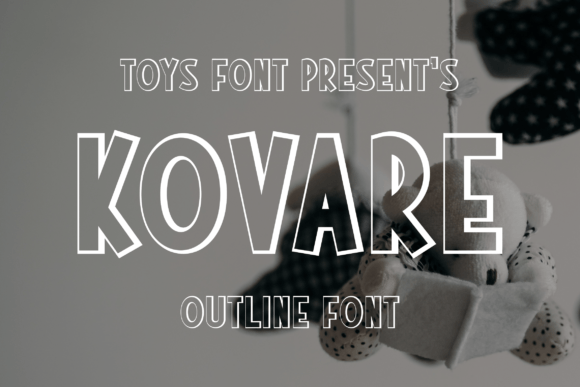
Kovare is an outline typeface, meaning its characters are rendered as open shapes rather than filled, solid forms. This gives it a distinctive, airy quality that feels light on the page or screen. The letterforms carry a rounded, approachable character—think soft edges and generous spacing—that naturally appeals to younger audiences and the adults who design for them. But what makes it more than just a "kids' font" is its underlying structure. The proportions are thoughtful, the weight distribution is even, and the overall rhythm holds together at various sizes.
For designers working on logotypes, packaging, or brand identity systems, this matters. A font that looks charming at display size but falls apart in smaller applications creates friction in a brand's visual language. Kovare's design holds up across contexts, which is something you notice when you start testing it in real layouts rather than just browsing preview images.
Where This Font Shines in Practice
If you're developing a brand for a children's clothing line, a toy company, a kids' educational platform, or a family-oriented service, Kovare offers a strong starting point for your headline and display typography. Its outline structure makes it particularly effective in situations where the font needs to interact with color, pattern, or imagery—because the open letterforms allow backgrounds and fills to show through, creating layered visual effects that a solid font simply can't achieve.
Consider a few practical scenarios:
- Packaging design for a children's snack brand, where the outline letters can be filled with product photography or bright patterns to catch a parent's eye on a shelf.
- Poster and event graphics for a kids' festival, school fundraiser, or family-friendly movie release, where the typography needs to communicate energy and warmth.
- Social media graphics for a parenting blog or children's book author, where distinctive typography helps content stand out in a crowded feed without relying on generic templates.
- Apparel and merchandise like t-shirts, tote bags, or stickers, where outline fonts translate naturally to print and embroidery applications.
- Logo design for startups in the toy, education, or entertainment space, where the font's personality can anchor the brand's visual identity from day one.
- Invitations and stationery for birthday parties, baby showers, or children's events, where a playful yet polished typeface sets the right tone.
These aren't hypothetical ideas—they're the kinds of projects where font choice directly influences how an audience perceives a brand. A children's bookstore using a stiff corporate serif on its signage sends a mixed message. A toy company using Comic Sans on its packaging signals a lack of care. Kovare occupies a middle ground that feels intentional: playful enough to be inviting, structured enough to be taken seriously.
Improving Visual Consistency Across Touchpoints
One of the most practical benefits of choosing a well-designed display font like Kovare is the consistency it brings to a brand's visual ecosystem. When your headline typography, logo wordmark, and key marketing assets all draw from the same typeface family, the result is a cohesive look that audiences begin to recognize over time. This is the foundation of brand recognition—repetition of distinctive visual elements that become associated with a specific identity.
Think about how brands like LEGO or Fisher-Price use typography. Their typefaces aren't just decorative choices; they're core components of how those brands communicate. Every time you see that specific letter shape, you immediately associate it with the brand's personality and values. For smaller brands and startups, adopting a distinctive font early on and using it consistently across websites, social media, print materials, and packaging creates the same kind of visual shorthand—just on a smaller scale.
Kovare works well in this role because its outline style is memorable without being distracting. It doesn't compete with product photography or illustration; it frames them. And because it's designed as a display font rather than a body text solution, it pairs naturally with simpler sans serif or serif fonts for longer copy, giving you a clear typographic hierarchy that guides the reader's eye.
Practical Tips for Working with Outline Fonts
Outline fonts require a slightly different approach than solid typefaces, and a few considerations will help you get the most out of Kovare in your projects.
Color and contrast matter more than usual. Because outline letters are defined by their edges rather than filled shapes, they rely on contrast against the background to remain legible. Test your designs on both light and dark backgrounds, and pay attention to how the font reads at the smallest size you plan to use it at. A thin outline on a busy background can get lost quickly.
Size generously. Outline fonts tend to work best at larger sizes—headlines, hero text, logos, and display applications. Using them for body copy or small UI text is generally not advisable, as the open letterforms lose definition when reduced. Pair Kovare with a clean sans serif for paragraphs and secondary text to maintain readability across your layouts.
Experiment with fills. One of the creative advantages of outline typography is the ability to fill the letter interiors with color, gradients, textures, or images. In design software like Adobe Illustrator or Affinity Designer, you can easily clip patterns or photographs into the letter shapes to create eye-catching effects that add depth to posters, social media posts, and packaging.
Check the full character set. Before committing to any font for a commercial project, review the complete character map. Look for the availability of numerals, punctuation, accented characters (especially if your audience includes multilingual markets), and any alternate styles or ligatures that might give you additional creative flexibility.
Understand the licensing terms. If you're using Kovare for commercial work—whether that's a client project, a product you sell, or marketing materials for your business—make sure the license covers your intended use. Most premium fonts come with clear licensing guidelines, and respecting those terms protects both you and the font designer. It's a small detail that prevents headaches later.
Font Pairing and Typographic Hierarchy
A display font like Kovare doesn't exist in isolation. It's most effective when it's part of a broader typographic system that includes complementary fonts for different roles. A common and reliable approach is to pair a distinctive display font with a neutral sans serif for body text—something like a geometric sans that doesn't compete for attention but shares a similar sense of openness and clarity.
You might also consider pairing Kovare with a simple handwritten or script font for accent text, such as callouts, quotes, or taglines, especially in designs aimed at a younger or more casual audience. The key is to limit yourself to two or three typefaces maximum in any single project. More than that, and the design starts to feel fragmented rather than unified.
When building your typographic hierarchy, assign clear roles to each font. Kovare handles headlines, titles, and logo work. Your secondary font handles subheadings and body copy. If you introduce a third font, use it sparingly for accents or emphasis. This structure makes your layouts easier to navigate and gives your brand a more polished, intentional appearance.
A Thoughtful Choice for Kid-Focused and Creative Brands
Choosing a typeface is never just an aesthetic decision—it's a strategic one. The fonts you use shape how people perceive your brand before they read a single word. For designers, entrepreneurs, and creators working in the children's market or in any space where approachability and creativity are valued, Kovare offers a distinctive option that bridges the gap between playful and professional. Its outline construction opens up creative possibilities that solid fonts can't match, while its careful design ensures it performs reliably across the kinds of applications that matter most: logos, packaging, posters, digital content, and branded materials.
Take the time to test it in your actual projects. Set your headlines, mock up a few layouts, and see how it interacts with your color palette and imagery. The right font doesn't just look good in a preview—it works hard across every touchpoint where your audience encounters your brand.