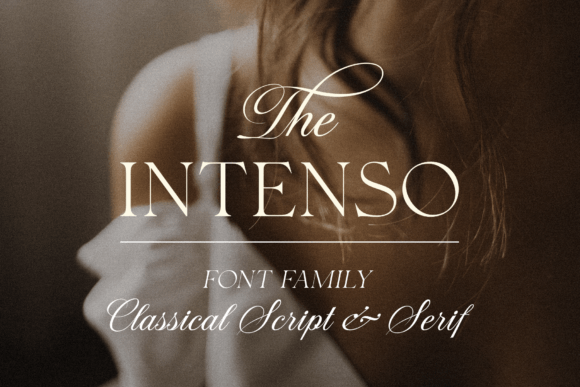
Intenso: A Font Family That Balances Elegance and Versatility
There’s a moment in every design project when the typography either clicks into place or throws everything off balance. You’ve seen it before—a beautiful logo rendered clumsy by a mismatched font, or an elegant invitation undermined by lettering that feels flat. The difference often lies in choosing a typeface that carries both personality and flexibility. Intenso is one of those rare font families that manages to feel cohesive while offering distinct styles, making it a practical choice for designers and creators who want their work to look polished without spending hours wrestling with font pairings.
Understanding the Three Styles Within Intenso
At its core, Intenso is a premium font family built around three complementary styles: a classic script, a sharp serif, and an italic serif variant. Each brings something different to the table, yet they share a visual harmony that makes them work together naturally.
The script style is where Intenso’s calligraphic roots shine. It’s not the kind of overly swirly script that sacrifices legibility for flair. Instead, it strikes a balance—elegant enough for wedding invitations and brand marks, but structured enough to remain readable at smaller sizes. One practical detail worth noting: the script includes alternates for both uppercase and lowercase letters. That means you can swap out a particularly ornate capital for a simpler version, or adjust the lowercase to better fit the tone of your project. For anyone working on logos or headline treatments, those alternates give you more control without needing to buy additional fonts.
The serif style takes a different approach. It’s all caps, with medium proportions and high-contrast strokes that end in sharp, defined serifs. This gives it a confident, editorial quality—think magazine mastheads, poster titles, or packaging that needs to command attention. Because it’s limited to capital letters, it’s best suited for headlines and short text blocks rather than body copy. But within that scope, it delivers a graceful, authoritative presence that pairs well with both the script and the italic serif.
Speaking of the italic serif, this style bridges the gap between the two. It adds a subtle sense of motion and sophistication, useful for pull quotes, subheadings, or anywhere you want to introduce emphasis without resorting to bold weights or underlines. Having all three styles in one family means you can build a complete typographic system for a brand or project without the guesswork of mixing unrelated fonts.
Where Intenso Works Best in Real Projects
Let’s talk about practical applications, because a font is only as good as what you can do with it.
Branding and Logo Design
If you’re developing a brand identity for a boutique business—say a florist, a jewelry line, or a high-end bakery—the script style offers that handcrafted, personal touch. Pair it with the serif for the tagline or secondary text, and you’ve got a logo system that feels cohesive. The alternates in the script are particularly useful here, letting you fine-tune the look of specific letter combinations that might otherwise feel awkward.
Packaging and Print Materials
Product packaging often needs to communicate quality at a glance. The serif style’s sharp, high-contrast letterforms read well on boxes, labels, and bags, especially when set in all caps. For artisanal or luxury products, combining the serif with the script creates a layered look—one style handles the product name while the other supports the descriptive text or brand story.
Social Media and Digital Content
On platforms like Instagram or Pinterest, where visuals compete for split-second attention, a distinctive font can make your graphics stand out. Intenso’s script works well for quote graphics, sale announcements, or story overlays. The serif, meanwhile, gives carousel titles and blog headers a clean, professional edge. Because the styles share a family connection, you can switch between them across different posts without losing visual consistency.
Invitations and Editorial Layouts
For event invitations—weddings, galas, product launches—the script style naturally fits the tone. But don’t overlook the serif for the details: date, time, venue information. Setting those details in the serif keeps them legible while maintaining the overall elegance of the piece. In editorial design, like magazine spreads or lookbooks, the italic serif adds variety to pull quotes and captions without disrupting the page’s rhythm.
Websites and Blogs
Web designers often struggle with script fonts because many lose legibility on screens. Intenso’s script, with its cleaner letterforms and available alternates, holds up better than most. Use it sparingly—hero sections, featured post titles, or call-to-action buttons—while relying on the serif for navigation labels or section headers. This approach keeps the site looking refined without sacrificing readability across devices.
Matching Typography to Your Project Goals
Choosing the right style from Intenso depends on what you’re trying to communicate. If your project prioritizes warmth and personality—like a handmade goods shop or a personal blog—the script is your starting point. If you need authority and clarity—think law firm branding, annual reports, or architectural portfolios—the serif takes the lead. And if you want to signal sophistication with a touch of movement, the italic serif fills that role.
A few practical tips for working with this family:
- Test at the size you’ll actually use. A font that looks stunning in a 72-point headline might feel cramped or overly delicate at 14 points. Set sample text at the sizes you anticipate and check how it reads on screen and in print.
- Pay attention to spacing. Script fonts, in particular, can benefit from adjusted letter-spacing depending on the word. Use your design software’s kerning tools to tighten or loosen specific pairs.
- Don’t overuse the script. It’s tempting to set entire paragraphs in the script style because it looks beautiful, but readability drops quickly with longer text. Reserve it for moments where elegance matters more than information density.
- Consider your audience. If your readers skew younger or your brand voice is casual, the serif’s all-caps, high-contrast design might feel too formal. In that case, lean on the script or italic serif for a softer approach.
- Check licensing before commercial use. If you’re using Intenso for client work, merchandise, or products you plan to sell, make sure your license covers that use. Many premium fonts have different tiers for personal versus commercial projects, and it’s worth confirming before you commit.
Building Visual Consistency Across Touchpoints
One of the biggest challenges in design—whether you’re a freelancer juggling multiple clients or a small business owner managing your own brand—is keeping everything looking unified. A font family like Intenso simplifies that process. Because the script, serif, and italic serif were designed to work together, you avoid the common pitfall of pairing fonts that clash in weight, proportion, or mood.
Imagine you’re creating a brand kit for a client: business cards, a website, social templates, and product packaging. Using the script for the primary logo, the serif for headings and labels, and the italic serif for accents creates a system that feels intentional. Customers start to associate those typographic choices with the brand, which strengthens recognition over time. That’s the real value of a cohesive font family—it’s not just about looking good in one place, but about creating a visual language that holds together across every touchpoint.
Intenso isn’t trying to be everything. It won’t replace a clean sans serif for your body copy or a bold display font for your loudest campaigns. But for projects that call for elegance, refinement, and a touch of calligraphic beauty, it offers a well-rounded toolkit. The three styles give you enough range to handle most design needs within a single family, and the included alternates add a layer of customization that many comparable fonts don’t provide.
If your work involves branding, packaging, invitations, or any project where typography carries the emotional weight, Intenso is worth exploring. Start with the style that fits your primary use case, then experiment with how the others can support it. You might find that the family does more of the heavy lifting than you expected.